Fake Parcel Delivery Texts: How to Recognise and Report Them
You are at home when suddenly your phone vibrates in your hand.
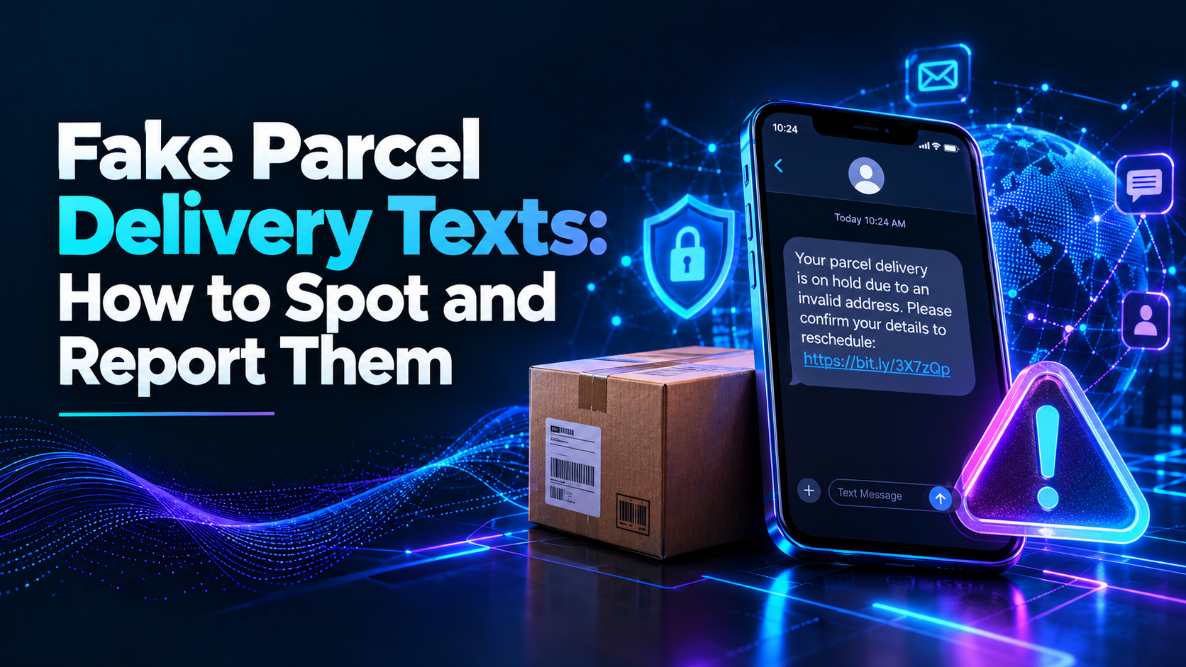
"Your parcel could not be delivered because your address is incomplete.
Update your details to arrange another delivery".
You look at the screen in confusion and think to yourself that maybe it was something you ordered a week ago or the message is telling you that the courier delivery driver failed to deliver it.
A suspicious link appears below the message, so you decide to just click it to update your details.
But what if there's no parcel at your house after all?
That's how many fake parcel delivery text scams start.
Fraudsters usually send out these messages offering help to customers with delivery issues.
However, they lure you with a deceptive text and an hyperlink and attempt to scam your confidential or payment information.
Fortunately, most of these texts contain several red flags suggesting that it is not an official message.
Once you learn how to spot these warning signs, it will be much easier to deal with such SMSs.
Understanding Fake Parcel Delivery Texts
Fake parcel delivery texts (also known as smishing) are SMS scams usually sent by fraudsters posing as courier companies.
They may impersonate both multinational delivery companies and local couriers dealing with private customer orders.
These fraudulent messages suggest either that the customer has missed their delivery, their warehouse address is incorrect or demands for a small payment to be made for redelivery.
Such texts contain links to fake websites that usually appear authentic.
However, their main purpose is to extract your private or payment data.
The most significant warning sign stating that an SMS is fraudulent is that it asks you to provide your personal or payment information.
But how can one distinguish between genuine and scam delivery alerts?
How to Spot Fake Parcel Delivery Text Messages
1. Look at the Sender's Information careFully
It goes without saying that one of the first things you should check when looking at any message is the sender.
Most of the time, a legitimate message will contain the company's verified phone number or name. But keep in mind that scam messages may also have sender IDs familiar to you.
That is why it is vital that instead of believing what the text says and clicking on the link provided, you double-check it via the courier's official website, application or contacting them directly.
2. Be Wary of links
The majority of these fake delivery texts contain a link asking you to claim or update delivery information.
The links usually lead to phishing domains that impersonate genuine courier websites or companies.
If you want to check the authenticity of an hyperlink, you should analyse the domain it leads to.
The link can also be deceptive using fancy names like parcel-update-help.example and other combinations of random letters.
Remember, always type the company's address in your browser to ensure that it is safe.
Even though domains that include 'https' or lock icon are also secured, scam websites may use them as well.
3. Do not fall under the Pressure
Scam artists usually try to force their victims into taking some immediate action.
They may use phrases like 'Your parcel will be returned within 24 hours,' 'It is the final notice about delivery failure,' 'You have to pay outstanding charges right now,' or 'Your goods will be destroyed due to inaction'. Such messages try to deceive you into making impulsive decisions.
However, as in all suspicious cases, there is always an ulterior motive.
A desperate approach is used by scammers who know how to manipulate their victims.
They pressure you so that you take reckless actions.
Never respond immediately to texts offering 'exclusive suggestions'.
4. Watch out for Unexpected payment Demands
Another warning sign that can be found in many fake delivery texts is a demand to pay an extraordinary postage or courier company fine.
These payments usually seem relatively affordable, so that you may think twice before paying extra and ignore the message.
Yet, fraudsters usually count on the fact that the reader may actually fall for their offer.
They intend to steal your card data so that they can empty your account. Always check whether the text asking for such fees is verified and reputable.
Even legitimate courier companies sometimes install additional charges.
Yet, if you are not confident about a suspicious message, it is advisable to double-check and refrain from providing the scammers with your payment data.
5. Be Cautious about Unexpected Deliveries
This final suggestion is one of the most obvious ones, but it can save you from multiple scams.
Before doing any suspicious action suggested in a text, such as updating delivery details, making an additional payment or providing confidential information, make sure that you actually expect this delivery.
Do you actually remember ordering some product? Is there at least a probability that this delivery may be real?
Double-check all pieces of information offered in the message.
You should also note the tracking number to access the real-time delivery status of a courier service.
It is not uncommon that many fake delivery texts are addressed to those who really expect deliveries.
After all, this tactic is quite effective.
How to Report Fake Parcel Delivery Texts
If a suspicious text turns out to be fraudulent, you should delete it as soon as possible.
Besides, it is also important to report it to authorities.
Here are several methods of doing that.
Report as Spam
Many of the modern day's apps offer customers to report messages as spam.
In some Android devices, the user is offered to reply to messages or block them in the menu conversation.
In phones running on iOS, messages which are spam are marked as such.
However, the options may differ depending on the specific device and network provider.
If you want to find the necessary menu, you need to research online or call your organisation offering spam-reporting services.
Report to Your Network Carrier
Most network carriers have a spam reporting system that enables you to send fake parcel delivery texts to them.
In many cases, users are encouraged to forward spam texts to 7726, which is the number for SPAM in phone keypad.
However, this option may depend on the country and specific organisation.
Inform the Courier Company About the Message
If you suspect that a delivery notification was sent via fraudulent means to you, you may ask the company to check it.
If a text's content suggests contact with a courier firm, inform them regarding text messages asking to provide private or payment information.
When you contact the organisation, write down all details on the website and phone number to avoid being mistaken in case fraudsters change their details.
Report Serious Fraud Cases
In some cases, scam delivery texts result in severe privacy or financial violations.
If your account was hacked, it is a good idea to inform the organisations in the country that deal with such criminal activities.
Provide them with all the necessary documents regarding this case to help identify the scam artists.
What to do If you Have Already Opened a Message with a Link
Sometimes it happens that we see a suspicious message and a link but nevertheless open it.
The next step involves several recommendations that largely depend on what you have done there.
In case you saw an hyperlink, but did not provide any personal information, close the page or do not download any files provided there.
If you did type an OTP or password anywhere on the website, instantly change it to something more reliable with the organisation's legitimate site.
Change it elsewhere if you have used the same OTP or password and set up an additional two-step verification when possible.
If the scam site asked you to provide the card details, contact the bank in a trustworthy way and ask for all actions that should be taken to cancel the transaction or block the card.
Never rely on phone numbers and links contained in such SMS messages.
If you have downloaded an application or any other files on your device, refrain from installing them and utilise your device's security protection features.
The faster you react to an incident, the better.
In case you did not operate any personal information on the website, wait until the authorities manage to identify fraudsters.
How to Stay Protected from Fake Parcel Delivery Texts
Staying protected from such scams does not require any special skills or time.
Several simple measures can make you feel secure and save your confidential or payment data.
- Do not respond to messages with suspicious links or request for money transfers.
- Track or follow all delivery information on the organisation's site or application to avoid scams.
- Never shareOTP or password with random senders.
- Do not fall victim to fraudulent activities when an urgent response is required.
- Update applications on your phone or electronic device and utilise only verified applications. Report spam instead of sharing them with others or sending to another user.
Remember, the fact that someone has sent you an alert does not mean that you need to respond to it immediately.
Sometimes it is necessary to cancel it or refrain from taking any action at all.
Final Remarks
Fake parcel delivery texts tend to look credible because scammers usually imitate real messages from couriers or delivery services.
However, their goal is to attract a customer by notifying about delivery issues that never happened.
They entice users with promises of instant solutions and convenient options that do not require any expenses or risk.
Yet, most usually, they are only pretending since they only aim for your money.
Next time your phone displays an alert about a delivery problem, first make sure that it is actually a real delivery.
A second spent on research will save you a lot of financial and personal inconvenience.
I truly hope that my article helps you distinguish fake from genuine delivery messages.