"Your Account Will Be Suspended" Messages: Real or Scam?
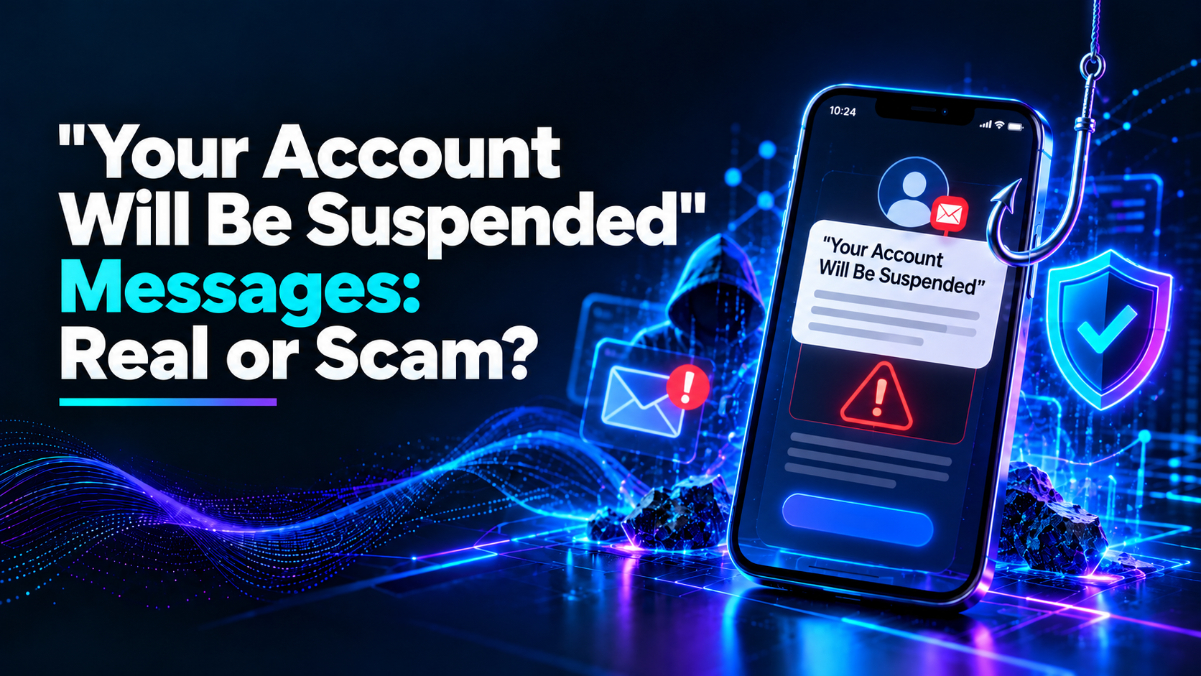
Suppose a message pops up while you are browsing on your mobile phone saying your account will be suspended within the next 24 hours. You may panic as who would want to lose access to their Facebook, Instagram, email address, or bank account? You may look for ways of fixing this mysterious problem that just emerged.
And this is exactly what fraudsters want you to do.
Suspension messages have become a common phenomenon on the internet and while some of them are genuine, others are crafted by cybercriminals intending to extract your personal information or launder money through your account. So how do you distinguish between the two?
What Are the Reasons Behind Suspended Account Messages?
There could be many reasons why you are receiving a suspended account warning message.
Sometimes, this message may contain a link that is clicked, and the website that opens is different than the one you intended to go.
This entire procedure is known as phishing.
Fraudsters pose as real companies to lure you into providing them with sensitive information that could help blackmail you or gain unauthorized access to your accounts.
In phishing, the fraudster usually sends a suspicious link to the target via email or other means of communication and manipulates the victim into believing in a false website that may appear to be real at first glance but turns out to be a phishing site. You may also see a request to update your credentials, passwords, or one-time pin verification (OTP).
A legitimate account warning could also have risen from the company's end as a response to unauthorized login attempts or violation of their policies.
Sometimes, there is no warning message but direct action like deactivating or deleting your account. However, such messages usually come through the official website of the company, so always check the hyperlinked website address before clicking or submitting any information.
Suspended Account Warning Message: The Major Signs
Even as scams may seem sophisticated, there are some major red flags that indicate such a message.
1. Creating A Sense Of Panic Or Urgency
Scam artists know the art of playing with human psychology and emotions to lure them into the trap. For example, in the case of a suspended account warning message, they will use language like "your account will be deleted in 12 hours", “immediate verification is required”, “this is your final warning before permanent deletion”, and “click now to avoid deletion of your account”.
Legitimate warnings may also use such language, so you should not rely solely on this indication. However, it should be enough to make you double-check other suspicious aspects of the message.
2. Suspicious Hyperlinked Address
Scam artists also disguise their fraudulent website link as a trustworthy company link. This can be achieved in two ways:
- The fraudster could use a link that is almost similar to a legitimate website link but with a different website address or URL.
- The fraudster could customize the web address as a short or custom link to mask the real link and trick you into clicking it.
Even as the website address could appear similar to the legitimate company's address, it is necessary not to fall for it.
The safer alternative would be to navigate directly to the company’s official app or website and confirm whether the warning is legitimate.
3. Request To Verify Your Password
One of the most prominent red flags is asking you to verify your password, OTP, or one-time verification code sent to your mobile phone or email address.
The fraudster is trying to extract your password, which could give them access to your entire digital world. It is therefore essential not to provide your passwords, OTP, or any other private information to random emails or website pop-ups.
4. Unusual E-mail Address
Sometimes, even though the sender’s name could appear to be legitimate, the email address could be completely different from the company’s email. Although this may not be an indication of fraud, it could provide vital information about the scam artist. For example, the scam artist could disguise themselves as a social media company and send the message via a random Gmail address. It is essential to double-check the sender’s email address before taking any action, such as clicking a link or replying to the message.
On the other hand, it is essential to understand that the sender’s name or email address could also be faked. If this happens, you should always remember that the email address cannot appear exactly like the company’s official name, so it should always raise suspicion.
5. Threats Or Unexpected Monetization Requests
Sometimes, while sending the warning message, the scam artist may request a payment as a way of verifying you as the account owner and deterring unauthorized account activities. These requests should always trigger suspicion, such as "a fine needs to be paid to continue using the application," or "your account is at risk of being deleted."
At the end of the day, there are ways of distinguishing between legitimate and scam warning messages. However, at this point, we can understand why such warning messages are dangerous and should only be dealt with caution.
Can The Suspended Account Warning Messages Be Real?
Although scam artists could pose as companies and dupe people, legitimate account warnings are also a reality, and should be taken with due diligence.
Companies usually send account warning messages if there are unauthorized login attempts, policy violations, account misuse, or other security concerns. So it is essential to understand that such messages do exist. However, always take caution before trusting the warning message or acting on the directions since fraudsters are good at disguising their phishing emails as legitimate warnings.
For example, if you notice a suspicious account warning message sent via email, it is best to open the Instagram application, check for any warnings, account lock policy, or account security procedures. If the warning message is legitimate, you will be informed without having to provide sensitive login information to a random email address.
So, in the next part, let us explore what to do if you receive such a suspicious warning message.
So You Received a Suspended Account Warning Message – Now What?
When in doubt, it is best to avoid clicking or interacting with any suspicious links and emails sent to your inbox.
Instead, you can follow these steps:
- Avoid interacting with suspicious links or pop-up ads.
- Go to the company’s official website or app.
- Check the account status and warning message.
- Go to the account activity center and look for suspicious log-in attempts.
- Use the official contact address or website to reach out to the company.
- Mark suspicious emails or ads as spam or phishing.
In the next part, let us analyze what to do if you clicked a suspicious account warning ad.
What Do You Do If You Accidentally Click A Suspended Account Warning Message?
Unless one has been blackmailed or harassed, clicking on a suspicious warning ad does not guarantee that your account will be deleted or suspended. On the contrary, it has been proven that some ad links are masked as official website links, which could dupe people into providing the wrong information. So what should you do?
Below are some of the essential steps to take:
- If you have entered your account or email password on a phishing website, change your account or email password on the company’s app or website.
- In the same way, it is essential to ensure the other accounts that you use with the same password, and change them if necessary.
- Install a two-step verification or passkey for the accounts to ensure that there are no malicious attempts to access the account.
- Ensure there are no unauthorized log-in attempts, and log them out if there are.
- If the phishing scam involves monetary information like your mobile money or financial service account and has asked to authorize a transaction, it is essential to contact the official mobile money or financial service company via their verified address and inform the appropriate authorities to block the fraudster.
- Similarly, if a suspicious website has asked you to download an application or other files onto your phone, it is best to avoid downloading any files and to scan the files with your phone security software if they have already been downloaded.
Why Do People Fall For Suspended Account Messages?
People always assume that people who fall for scam are gullible or uneducated individuals who do not understand how to use technology.
However, this assumption is entirely false since phishing and internet scams usually exploit human psychology and behavior. For example, scam artists do an extensive psychological scan of potential victims to customize the scam and lure them into the trap.
Therefore, even an experienced internet surfer can fall for a well-crafted scam plan and lose valuable data that could adversely affect a personal or business life.
How Can You Protect Yourself In Future?
Account protection is relatively simple and should not require any additional costs unless you choose to use a password manager to generate unique passwords for different accounts.
However, the most critical thing is always to avoid revealing personal and private information to suspicious website pop-ups, emails, and short message service (SMS) notifications. Also, remember to always navigate to the official company website or application when logging in or making a transaction.
Takeaway
Suspension messages are usually sent by fraudsters who intend to extract private information from the target.
The best way to protect oneself is to always check the account activity center in the official company application or website and ensure the account activity is normal.
The message may have been sent as a result of unauthorized account access, and it should raise red flags.
Therefore, while account warning messages could be legitimate, the most crucial thing is to avoid clicking on suspicious links or sharing private information with random emails.