Fake Prize and Lottery Messages: 6 Red Flags
Imagine receiving an unexpected message on your phone: "Congratulations! You've won $50,000 in our exclusive lottery. Kindly click the link below to claim your prize."
As you read this, you probably feel excited.
Who wouldn't be at the thought of obtaining unexpected wealth?
However, you may soon realise that the message is attempting to deceive you.
You did not participate in any lottery, and the notification is pressuring you to pay a processing fee.
Fake prize and lottery messages are a form of deception.
Fraudsters utilising SMS, WhatsApp, email, or social media announce that you have won a prize but ask for payment, personal information, or access to your online accounts as a condition for claiming the reward.
The message may even use the name and logo of an actual company.
Recognising the warning signs can help you realise that you are being deceived.
I will discuss six common red flags that can help you spot fake prize or lottery messages. Let us begin by defining these fraudulent messages.
What are fake prize and lottery messages?
Fake prize notification messages are misleading and deceptive to entice recipients into revealing personal and financial information.
Fraudsters utilise the appeal of winning something valuable, like money, smartphones, or gift cards.
There may be an appearance of legitimacy because an organisation's name or logo is used in the message.
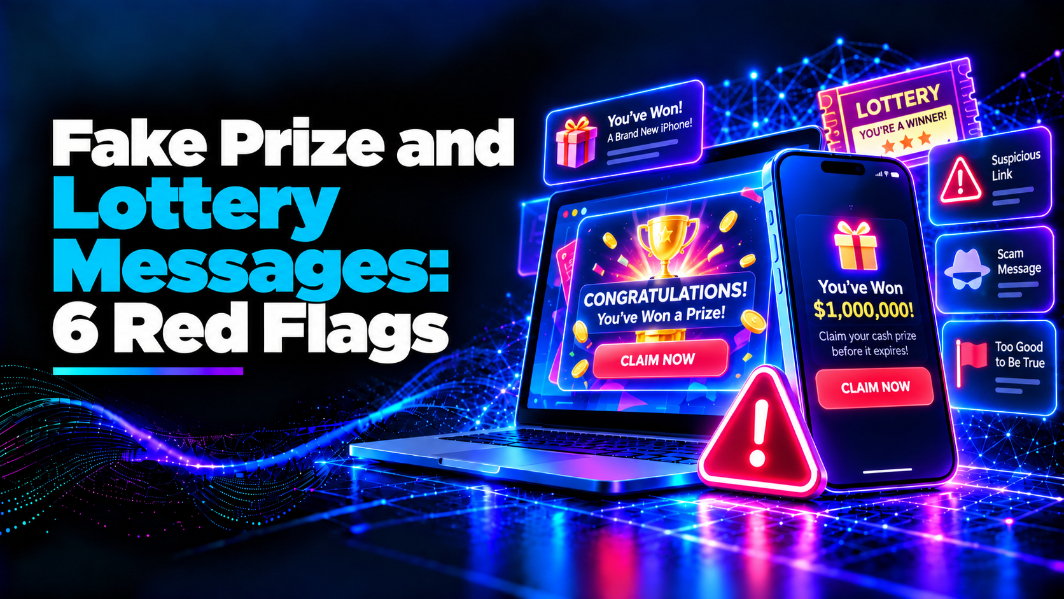
An example of a deceptive prize message is: "Congratulations! You have won $25,000 in our international lottery. Kindly click the link below to verify your identity and claim your prize."
Meanwhile, messages offering other rewards can also be deceptive.
Another example is: "Congratulations! You've won an iPhone. Your voucher number is 637205. Kindly share your billing address and phone number to deliver the prize to you."
The scammers' aim is to convince you that you are about to receive something wonderful.
However, they will most likely ask for a fee or payment method before you can obtain your supposed prize.
Sometimes, the fraudster will ask for personal information to confirm that you are the legitimate owner of the prize.
These messages can be delivered in various ways, such as through WhatsApp, SMS, email, or social media.
You could also see the message as a pop-up advertisement on a website.
Each method may have slightly different rules, but they are all utilised with the same goal of scamming.
Now that we understand what fake prize or lottery messages are, let us discuss some of the warning signs.
6 Red Flags of Fake Prize and Lottery Messages
I have listed six red flags that can help you determine if the prize notification you have received is fake.
1. You did not enter your details for any prize or lottery
One of the initial red flags occurs when you receive a message that states you have won a prize, but you do not recall entering an application.
A message such as "Congratulations! Your mobile number has been selected as the winner of our $100,000 international lottery" seems impressive, right?
This kind of message uses an impressive prize value to entice you to act immediately.
However, consider this: If I did not enter my details for the prize or lottery, then who did?
Any genuine prize message should state the process that you undertook to enter the competition.
Furthermore, you should be able to easily find the competition's rules on the company's official website.
In these fake messages, scammers usually select random names or phone numbers from a database.
Sometimes, the message will mention that the prize was awarded randomly or that you were picked from an international database.
Any method used to award prizes should be stated clearly and concisely.
If this information is not provided or the procedures seem suspicious, you should take caution.
2. You are asked to pay a fee before you can receive the prize
Another red flag is that the prize message will ask for your payment information before you can claim your prize.
For example, the message may say: "You have won $10,000! Please pay a $50 processing fee to release your payment."
The message may suggest that payment is required to authorise the release of the prize.
You might think that the processing fee is just a small amount compared with the prize value.
The scammers know that if they begin with a small amount, they will persuade you to pay increasingly larger amounts.
However, the problem arises when the fee is not released to you after you paid it.
If you have not yet paid the processing fee, you should not provide the necessary financial information.
I usually advise people to ask themselves questions such as "Why do they need this information?" and "Should I have entered this competition?"
I will provide some tips to help you deal with situations such as these. For now, let us identify the remaining red flags.
3. The sender requests sensitive personal information from you
Not all fake prize messages will ask for your payment details.
Some of them will request your sensitive personal information.
For example, the message might state: "To release your prize, kindly provide us with your full names, bank details, national identity number, and verification code."
This message could be a red flag because it asks for your bank details and national identity number.
Fraudsters can utilise this information to withdraw money from your account or impersonate you.
This kind of message can be particularly harmful to you or your business.
The message asks for a verification code, which suggests that the sender will try to access your account, application, or website.
A verification code is also known as an OTP (one-time password).
I will explain why OTP is dangerous later.
Meanwhile, let us discuss some of the other red flags.
In some cases, the sender might request your login details for social media, email, or banking platforms.
The message may also ask for your password or pincode.
These are all red flags because the fraudsters can utilise the information to access your online accounts and steal your money.
4. The sender creates a false sense of urgency
Another red flag is that the message will use an urgent tone to pressure you for a prompt response.
For example, the message may say "URGENT! You have 15 minutes to claim your $20,000 prize.
After that, the prize will be cancelled.
Kindly reply to this message immediately."
Scammers usually utilise this countdown technique when they want you to respond as soon as possible.
Another example of this countdown technique is: "Final reminder! Your lottery reward expires today.
Kindly complete verification."
You must take caution in such situations because the countdown is artificial.
The sender is merely trying to scare you into giving them your payment information before you can think about the consequences of your actions.
The message may threaten to withhold the prize if you do not comply.
In addition, the fake messages may suggest that another person could take the prize if you fail to meet the deadline.
In summary, the scammers utilise urgency to encourage you to respond immediately.
They use methods such as a countdown to give you a false sense of urgency.
In reality, there is no urgency at all because there is no legitimate prize to claim.
However, if you reply to the message, you risk providing the sender with the information they need to access your social media, banking, and other online accounts.
Do not be pressured into providing any personal information.
Let us continue discussing the other red flags.
5. There are suspicious links, website addresses, and sender addresses
Most fake prize or lottery messages will contain a link.
The link is either embedded in the body of the message or attached as a file.
However, clicking this link could lead you to a fraudulent website that asks for your personal information, payment details, and other sensitive data.
In some cases, the link could be a shortened version that conceals the actual website address.
The fake website address could use a combination of letters and numbers, making it difficult to determine if the website is legit.
For example, fraudsters might use "https://www.paymebank.com/1x2345/" as a website address.
Some of the techniques that scammers use to create fake website addresses are:
- Combining a company's name with unrelated words
- Using special characters to replace letters, such as '@' instead of 'a'
- Using an unfamiliar top-level domain (TLD), such as ".co", ".me", and ".io"
Once you click the link, you may be directed to a fake website designed to deceive you.
Now, let us discuss how scammers create fake websites so that you will understand what to look for when you see a suspicious link.
Most websites have a trust seal at the beginning of the web address.
This trust seal utilises some encryption techniques to protect the website's information.
However, this does not guarantee that the website is safe or legitimate.
Scammers use logos, trust seals, certificates, and countdowns to encourage you to believe that the website is legitimate.
They will replicate the website's layout and utilised professional marketing techniques to ensure that you provide the information they need.
Scammers may also utilise pop-up messages to demand your sensitive information.
Some fake websites will use testimonials and fabricated content to convince you that their service is reliable.
However, testimonials are merely words, and the content could be copied from legitimate websites.
Even websites that utilise encryption and protection seals can be unsafe.
Trust seals only confirm that the website has some encryption.
Therefore, you should always be wary of websites that request sensitive information, such as sensitive personal details, bank information, or passwords.
At this point, I am sure that you are wondering how you can verify the website's legitimacy.
The most reliable method is to ask yourself if the website has a legitimate reason to ask for your sensitive information.
If you believe that the website may be unsafe, you should use another device to access the website.
You should also try to determine whether the website has an official physical address.
Another option is to ask a friend to view the website and provide their feedback.
These are some of the steps that you can take to identify suspicious links, website addresses, and sender addresses.
Let us continue discussing the other red flags.
6. The prize that you won sounds amazing
The final red flag occurs when the prize that you have supposedly won sounds amazing.
The scammer usually offers an exceptionally generous prize in the hope that you will not critically analyse the situation.
After that, the fraudster will request that you complete specific procedures to claim the prize.
For example, the message may state:
"Congratulations! Your phone number has been selected as the winner of our international lottery.
The prize that you won includes a luxury-car, a large sum of money, and a new smartphone.
Kindly provide us with your phone number so that we can contact you."
The message may appear impressive at first, but the fact that you did not enter into any lottery is a red flag.
Scammers utilise amazing offers to lure you into giving them your sensitive information.
They will also utilise the company's name, such as Microsoft, Meta, and Vodafone, to give the impression that the prize is legitimate.
They may even fabricate an image of a happy customer to convince you that the prize is legitimate.
Fraudsters occasionally utilise trust seals, such as "100% Verified," to give the impression that the website is secure.
However, you should always analyse the situation before you provide any information.
At this point, I am sure that you are wondering what you should do next.
I will continue discussing the other red flags before I conclude this article by providing some final thoughts.
Now that we discuss all of the red flags, I believe that you will understand why most fake prize messages are dangerous.
Let us conclude this article by discussing how you can utilise these red flags to determine if a prize message is fake.
How to determine if a prize message is genuine
Not all prize messages are fake, but business owners will utilise prize messages to promote their products and services.
Therefore, it is essential to know how to determine if the message is legitimate.
Below are some questions that you can ask yourself:
- Did I actually enter this competition?
- This question is vital because you should not provide the sender with any personal information if you did not enter the competition.
- Is the competition available on the organisation's website?
- You should navigate to the organisation's website and look for information regarding the competition
- Does the organisation have trustworthy rules and regulations?
- You should analyse the organisation's rules and regulation to determine if the organisation is trustworthy.
- Can I verify the sender?
- You can utilise various online sources to determine if the organisation is trustworthy.
I will also provide some tips to help you determine if a prize message is genuine.
Before you provide the organisation with sensitive personal information, you should utilise a few tips.
- Ensure that the procedure does not involve paying a fee.
- Do not share passwords, OTPs, or sensitive personal information.
- If you are not certain whether the message is legitimate, request that the organisation send you an official letter.
Each of these tips will ensure that you remain protected when you utilise online platforms.
The fraudsters utilise various tactics to convince you that the prize message is legitimate.
They may also utilise fake phone numbers to give the impression that the organisation is legitimate.
However, their ultimate goal is to deceive you into providing them with sensitive information, such as payment details or passwords.
These scammers understand that an individual will comply without questioning the situation if the message sounds impressive.
Now, let us discuss the actions that you should take after you receive a fake lottery message.
What should you do when you received a fake lottery message?
When you receive a suspicious lottery or prize notification, a few simple steps can help you protect your personal information and finances.
After you have understood the red flags, you will be better equipped to know what to do if you receive a suspicious message.
1. Do not click any of the links
The easiest solution is to avoid clicking any of the links.
This precaution will prevent you from visiting any scam websites that want to obtain your sensitive information.
2. Do not reply to the messages
You should not reply to the message or share your sensitive personal information.
Replies will give the fraudsters the opportunity to request additional information or send you more messages.
3. Block the contact
Blocking the contact is also an excellent way to ensure that you do not receive any further messages from the sender.
However, blocking the sender will not guarantee that they cannot utilise another channel to contact you.
This precaution will still help you avoid further from the scammers.
4. Report the message or contact
Many apps and email systems have an option that allows you to report scams, abusive messages, or unwanted calls.
You can utilise this function to ensure that the sender is marked as unwanted.
5. Inform your family members and friends
If you are certain that the message is a scam, you should warn your family members or friends who utilise the same mobile network or email system.
This precaution is particularly essential if the message is a group message, as this indicates that all of the members of the group have received it.
You should advise your friends to be wary of messages that utilise fake phone numbers or email addresses.
It is not always a wise idea to forward the messages to your family members and friends unless it will help to expose the scammers.
After you have utilised these precautions, you can analyse the message or contact once again.
You can also utilise the following questions to determine what happened.
6. What did the message ask you to do?
This information is essential because it will guide your actions.
For example, if you clicked a link that directed you to a legitimate company's website, you should analyse the contact details that the company provided.
However, if you provided your password after you clicked a suspicious link, you should change your password immediately.
You will need to utilise the appropriate strategy to ensure that you are protected.
Let us continue discussing what you should do after you have received a fake message.
7. Did you provide the contact with any of your details?
This information will determine whether you will need to take further action.
For example, if you provided the contact with your password, you should utilise the appropriate procedure to change your password.
In some cases, the scammer may have accessed your account, and you will need to contact the company to ensure that your account is secure.
This situation may sound complicated, but it will help you ensure that your personal information remains safe.
You can utilise many tips to protect yourself against fraudsters.
I will provide a few useful tips that you can utilise in daily life to avoid scam artists.
Final thoughts
Fake prize and lottery messages can appear anywhere from your mobile network to online platforms such as WhatsApp, SMS, and email.
Fraudsters will promise you a prize that seems too good to be true.
However, they will utilise a series of tricks to get your personal details and passwords before they disappear.
I have identified six common red flags when discussing fake prize messages.
The red flags are an essential way to determine if the prize message that you received is legitimate or not.
If you are not certain whether the message is legitimate, do not give the sender any personal information or payment details.
Protecting your personal information and online accounts is always more important than winning a prize.
In conclusion, this article will help you understand how you can utilise red flags to determine if a prize message is fake.